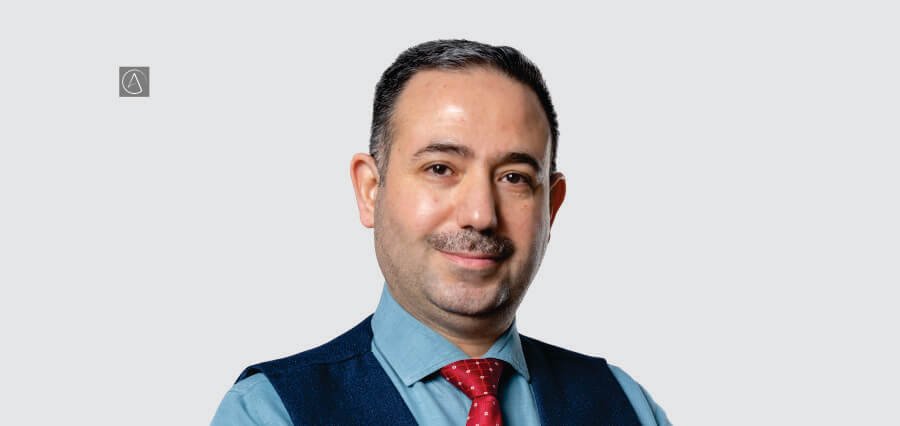
High above Riyadh’s skyline, where modern skyscrapers meet the desert sun, Muhannad Al-Sraihiny’s impact can be felt in every sophisticated system, predictive insight, and effectively managed facility. In 2000 he graduated as a computer engineer and began his career teaching programming, networking, and systems administration in classrooms rather than boardrooms or high-rise offices. Recognizing the gap between theoretical knowledge and practical application, he co-founded BITS in 2006 and created NUB.CAFM, a platform that altered facility management in Saudi Arabia, resulting in contracts with many prestigious clients in government, semi-government, public and private sector.
Beyond technology, he has been a catalyst for education and professional growth. Through Estidama, he trained hundreds of facility management professionals, bridging global best practices with regional realities. Today, as Director of Innovation at FMTECH, he is leading transformative projects like Shaheen, a drone-based façade inspection platform which contributes to national initiatives such as Deem, creating integrated ecosystems for smarter urban management.
With a career spanning over twenty-five years, Muhannad Al-Sraihiny embodies the fusion of technical expertise, strategic vision, and human-centered leadership, shaping not only the infrastructure of Saudi Arabia but the professionals and systems that will define the next generation of intelligent, sustainable cities.
From Code to Cloud: The Early Years
Muhannad Al Sraihiny’s journey began in the classroom, not the boardroom. As a senior instructor at New Horizons in 2001 till 2006, he taught programming languages, networking, and systems administration. But teaching wasn’t enough. He saw a gap between theoretical knowledge and practical application, particularly in how Middle Eastern businesses managed their physical assets.
In 2006, he took the leap. He co-founded BITS (Binary Integrated Technology Solutions), determined to create software that would revolutionize how organizations manage their facilities. Starting with a small team and limited resources, he personally guided the development of NUB.CAFM, a comprehensive platform that would eventually become the backbone of facility management across Saudi Arabia.
“I didn’t just want to build software. I wanted to create a system that understood our region’s unique challenges, our climate, our architectural styles, our regulatory environment and culture,” he recalls.
Over the next decade, he transformed BITS from a startup into a regional technology leader. He negotiated partnerships with Huawei, making BITS the first Huawei Technology and Cloud Partner in Saudi Arabia. He secured contracts with the Ministry of Health, Ministry of Interior, Ministry of Finance, Saudi Aramco, CSC, SFDA, SPL and many others. The company grew at a minimum average of ten percent annually, driven by innovation and an unwavering commitment to client success.
Educating an Industry
But Muhannad Al-Sraihiny understood something crucial: technology alone doesn’t drive transformation the people do. In 2014, he co-founded Estidama, Saudi Arabia’s first dedicated Facility Management Training Center. As Vice President, he authored two pioneering courses: “CMMS Theory & Practice” and “Fundamentals of Facility Management.” The Technical and Vocational Training Corporation officially registered these programs, marking the first such certifications in the Kingdom.
His commitment to education earned him recognition from the International Facility Management Association. In 2015, he became one of the first Arabic-speaking IFMA Qualified Instructors, bridging the knowledge gap between Western facility management practices and Middle Eastern operational realities. He also earned certifications as a Facility Management Professional and Facility Manager from the Middle East Facility Management Association.
Through Estidama, he trained hundreds of professionals, preparing fresh graduates for entry-level positions and equipping experienced managers with advanced skills. He didn’t just teach software operation, he taught strategic thinking, problem-solving, and the art of integrating technology with human workflows.
The AI Awakening
By 2023, Muhannad Al-Sraihiny had proven himself as both entrepreneur and educator. FMTECH, recognizing its unique blend of technical expertise and strategic vision, recruited him as Technical Applications Director. Within a year, he advanced to Director of Innovation, where his focus shifted dramatically to artificial intelligence and machine learning.
He enrolled in MIT’s No Code AI and Machine Learning, followed by Caltech’s Postgraduate Program in Artificial Intelligence and Machine Learning program, then a doctorate degree in AI Applications from the University of Kennedy. These weren’t vanity credentials! He immersed himself in neural networks, supervised and unsupervised learning, recommendation engines, and computer vision. He studied under leading researchers, completing intensive projects that bridged theory with real-world application.
The knowledge transformed his approach to facility management. He identified many critical use cases where AI could revolutionize the industry, such as: Comprehensive Smart Inspections, Generative Reporting, Optimized Decision-Making, Behavioral Pattern Tracking, Benchmarking and Performance Ranking, and Supply Chain Monitoring. Each use case addressed specific pain points which he observed throughout his career wasted resources, delayed responses, incomplete data, and reactive rather than proactive management.
Shaheen Takes Flight
The breakthrough came with Shaheen, an AI-powered façade inspection platform developed in collaboration with Google, Boston Consulting Group, SenseTime a global leader in artificial intelligence and FMTECH’s team. As a Product Owner, Muhannad Al-Sraihiny guided the platform’s development from the concept to the MVP, Minimum Viable Product in just four months.
Traditional façade inspections require workers to scale dangerous heights using scaffolding, rope access, or suspended platforms. The process takes weeks, costs hundreds of thousands of dollars, and puts lives at risk. Shaheen changed everything.
Drones now capture high-resolution images of building exteriors. AI algorithms analyze these images, detecting cracks, stains, wear, missing elements, and debris with accuracy that matches and often exceeds human inspectors. The platform generates comprehensive inspection reports, complete with defect classifications, severity assessments, and maintenance recommendations.
What once took a week now will take four hours. Costs drop by seventy percent. Most importantly, inspectors no longer risk their lives on high-rise exteriors.
“We’re not just saving money. We’re saving lives and reducing our carbon footprint. Every traditional inspection consumes enormous resources and time, such as fuel for lifts, materials for scaffolding, licensed workers, and energy for extended operations. Shaheen makes inspections faster, safer, and more sustainable,” he emphasizes.
The platform employs a modular AI architecture that allows dynamic model updates. As new building materials emerge or defect patterns evolve, engineers can seamlessly expand the algorithms. The system learns continuously, improving its accuracy with each inspection.
Building the National Infrastructure
Muhannad Al-Sraihiny’s vision extends beyond individual projects. He coaches and contributes to Deem, a strategic national-level platform that serves as Saudi Arabia’s facility management hub. Deem functions as a virtual container, encompassing all systems, solutions, applications, and data repositories related to facility management across the Kingdom.
The platform is divided into two components: Deem Operations Platform (DOP), which handles all field services and operational activities, and Deem Integration Platform (DIP), which encompasses the data lake, integration layers, and system connectors. Together, they create a unified ecosystem where facility data flows seamlessly between organizations, enabling benchmarking, performance analysis, and strategic planning at a national scale.
Deem provides the infrastructure necessary to implement all six AI use cases Muhannad Al-Sraihiny identified. Real-time IoT sensors feed predictive analytics engines. Integration architectures connect legacy systems with modern platforms. Data standardization ensures consistency across diverse sources. The platform leverages open-source big data technologies for scalability and innovation.
He contributed to developing the five-year roadmap that charts Deem’s evolution from initial deployment to full operational maturity. The plan encompasses multidisciplinary projects across various technical levels, coordinating efforts among government agencies, private contractors, and technology providers.
Partnering with Giants
In his role as Head of Technology, Muhannad Al-Sraihiny spearheaded FMTECH’s strategic partnership with IBM, creating Daem, an advanced AI solution that revolutionizes how organizations interact with facility data. Daem integrates Maximo, Cognos, and WatsonX, allowing users to generate custom dashboards and receive proactive insights simply by typing requests in natural language.
He orchestrated intensive workshops with IBM and FMTECH teams, analyzing business drivers and client requirements. He identified critical gaps: limited data visualization, disparate systems preventing unified reporting, lack of automation in work order creation and scheduling, and insufficient Arabic language support.
The solution he championed addresses these challenges directly. Daem features specialized Arabic AI agents for autonomous multi-system operations. It integrates custom vision models with Oracle ERP and ClockWorks Fault Detection platforms. Natural language processing generates tailored reports and visualizations specifically designed for the Saudi market.
“We’re not importing Western solutions and forcing them to fit. We’re building intelligent, market-specific platforms that understand our language, our regulatory environment, and our operational context,” he explains.
The Road Ahead
Muhannad Al-Sraihiny has received his Doctorate in Artificial Intelligence and Machine Learning from Kennedy University. He views his academic journey as natural progression rather than a departure from practice. He aims to explore the ethical, operational, and technical dimensions of AI deployment in business environments, contributing frameworks that support sustainable growth and strategic agility.
His research focuses on leadership development, strategic transformation, and thought leadership at the intersection of AI and facility management. He plans to mentor emerging leaders, advise organizations on sustainable growth strategies, and share insights through academic publications and professional engagement.
“This doctorate isn’t about collecting another credential. It’s about deepening my ability to contribute to push the boundaries of what’s possible when we combine human insight with machine intelligence,” he states.
His portfolio now includes more than thirty digital transformation projects spanning CAFM/CMMS, ERP, Contract Management, IoT, Access Control, CCTV, Building Management Systems, and energy management. He holds certifications from Microsoft, CompTIA, CISCO, Alibaba, and IBM. He maintains memberships in IFMA, MEFMA, the Saudi Council of Engineers, and the Syrian Computer Society.
A Legacy in Progress
From instructor to entrepreneur, from software developer to strategic innovator, Muhannad Al-Sraihiny has consistently positioned himself at the frontier of technological transformation. His twenty-five-year journey reflects a rare combination: deep technical expertise, strategic business acumen, educational commitment, and the vision to see not just what technology can do today, but what it must do tomorrow.
As Saudi Arabia accelerates its Vision 2030 initiatives, transforming cities into smart, sustainable ecosystems, his work provides essential infrastructure. The platforms he builds, the partnerships he forges, and the professionals he trains will create the foundation for intelligent urban management.
Looking up at those Riyadh skyscrapers with their AI-monitored façades, predictive maintenance systems, and interconnected building management platforms, Muhannad Al-Sraihiny sees progress. But he also sees possibility: a future where buildings don’t just house human activity but actively participate in creating safer, more sustainable, more efficient cities.