
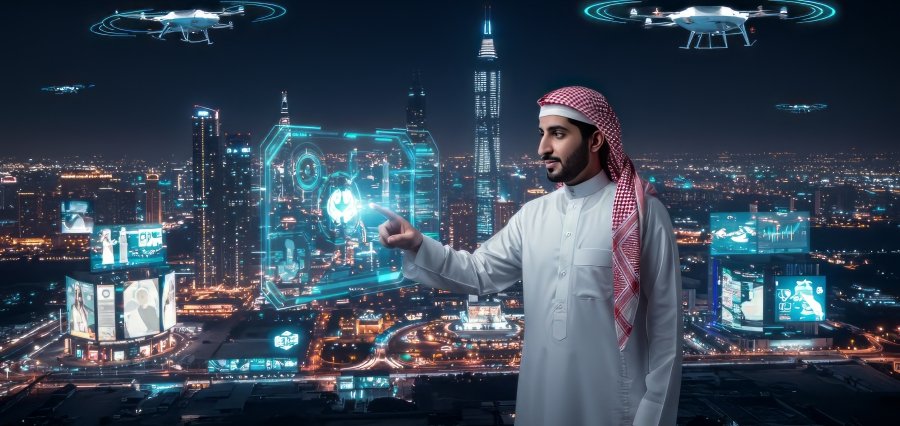
A decade ago, a young engineer in Dubai had to fly abroad just to pitch her startup idea to serious investors. Today, she could walk into a government-backed accelerator a few blocks from her apartment and get funded within weeks. Nothing about her ambition changed. What changed was the Middle East technology landscape around her.
That shift did not happen by accident. Governments, entrepreneurs, and investors across the region made deliberate choices, choices that turned a handful of oil-dependent economies into some of the fastest-growing tech hubs in the world. The story is still being written, but the direction is already clear.
This blog discusses how Middle East technology has evolved in recent years, what is driving Middle East innovation across the region, and why the rest of the world is starting to pay closer attention.
A Region Reinventing Itself
For years, outsiders pictured the Middle East mainly through the lens of oil and gas. That picture no longer tells the full story. Middle East technology now touches nearly every sector, from banking and healthcare to logistics and entertainment, often built by local teams solving local problems first.
Government investment was an important element in the transition. Many countries have tried their best to build up the digital infrastructure and use broadband connections and even cloud computing facilities for startups to spring up. This was not just about buying equipment. It reflected a genuine bet that Middle East innovation could become a lasting economic pillar, not just a temporary trend.
The Cities Leading the Charge
A handful of cities have become the visible face of this transformation. Dubai built itself into a magnet for fintech and logistics startups, helped by clear regulations and a business-friendly visa system. Riyadh followed with its own wave of investment, backing everything from e-commerce platforms to advanced manufacturing.
Smaller hubs matter too. Cairo has quietly become one of the region’s largest startup ecosystems by sheer volume, driven by a young, tech-literate population hungry for opportunity. Amman and Beirut, despite facing real economic challenges, continue to produce skilled engineers who now work across the wider region and beyond. Middle East technology is not confined to a single city or country. It is a genuinely regional movement. Middle East technology is gaining momentum as more cities compete to attract startups, investors and skilled technology professionals.
Where the Real Innovation Is Happening
Fintech stands out as one of the clearest success stories. Digital payment platforms and mobile banking apps have expanded access to financial services for millions of people who previously relied entirely on cash. This kind of Middle East innovation solves a very real, everyday problem, which is part of why it has scaled so quickly.
Healthtech tells a similar story. Telemedicine platforms, AI-assisted diagnostics and digital health records have enhanced access to care in areas previously limited by distance and lack of specialist availability. Meanwhile, logistics and e-commerce companies have built delivery networks that now rival established players in far more mature markets.
Artificial intelligence deserves special mention here too. Various governments have recognized AI as a national strategy by establishing AI research centers and urging universities to develop special programs. The emphasis has already influenced the way technology will evolve in the Middle East region, with AI becoming an integral part of even traffic and customer service systems.
The People Behind the Progress
This is all possible because there are people ready to take chances. More and more young professionals in the region are opting for entrepreneurship rather than pursuing the traditional, secure route to success after seeing their peers achieve it. Changes in universities have also been seen, with coding bootcamps and startup accelerators being introduced as parts of the curriculum.
But women have also become a critical component of this whole development process. Women founders and software engineers are increasingly becoming a key part of the technology sector in the Middle East, more so than most outsiders realize. This broader participation strengthens the ecosystem as a whole, since diverse teams tend to spot different problems worth solving.
Challenges That Still Remain
Growth this fast rarely comes without friction. Access to funding still varies significantly by country, and some promising startups struggle to scale simply because local capital markets remain smaller than those in Europe or North America. Talent retention is another ongoing challenge, since skilled engineers sometimes still move abroad for higher salaries once their skills mature.
Regulatory frameworks also continue to catch up with the pace of Middle East innovation itself. Rules around data privacy, digital banking, and cross-border commerce are improving steadily, but they still lag behind the fast pace of the startups they are meant to support.
Why the World Should Pay Attention
None of this progress is happening in isolation. This has not gone unnoticed by international investors, as regional startups and global firms are increasingly forging partnerships. With technology in the Middle East developing further, it is providing other emerging markets with a lesson on how strategic government investment can drive private-sector development. The rapid growth of Middle East technology is also creating new opportunities for international companies looking to enter the region’s expanding digital economy.
The region also offers something else worth watching: proof that transformation can happen quickly when ambition, capital, and talent align at the same time. What took other markets decades has, in some cases, taken this region only a handful of years.
A Story Still Being Written
Middle East technology has moved from a promising idea to a genuine global force in a remarkably short time. The combination of governmental support, visionary founders, and enthusiastic investors is making it seem like an event not temporary but rather an irreversible trend. Middle Eastern innovation is not just an interesting phenomenon to observe anymore, and it is rapidly turning into a case study to look at in close detail.