
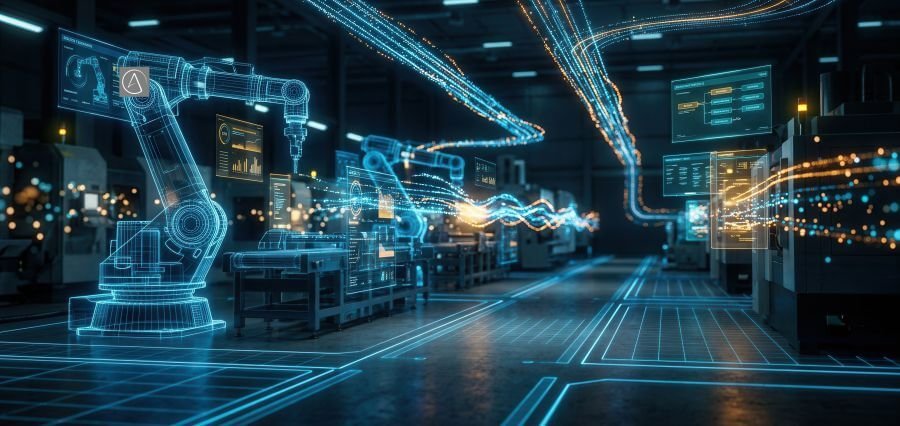
The new industrial revolution is coming, where the efforts of manufacturers are aimed at improving efficiency and adaptability. Conventional approaches to manufacturing have yielded good results over the years, but some of them still rely on manual processes, siloed operations, and a lack of visibility into the performance of their processes. Smart Manufacturing is revolutionizing manufacturing by integrating machines, people, data, and processes using advanced technology. The approach will assist manufacturers to make sound decisions, act promptly when the need arises, create an efficient and adaptive manufacturing environment and other benefits.
This is not only about implementing new technology or new digital tools. It is about shifting towards a different approach to designing, managing, and optimizing manufacturing operations. The emerging possibilities related to the Internet of Things, artificial intelligence, robotics, cloud computing, big data, and digital twins can lead to better tracking of the company’s operations and spotting areas where it can be improved. In combination with proper business strategies, these technologies will allow boosting efficiency and laying the groundwork for an ongoing industrial transformation.
Connected Operations
One of the most important advancements in modern manufacturing is the capability of integrating machines and processes that were separated before. The use of sensors and other industrial connectivity solutions will allow information gathering about equipment, production processes, and logistics. In this way, the company will have a better picture of production efficiency, the state of equipment, energy usage, and disruptions. It is no longer necessary to wait for periodic reports or inspection results to make decisions, but information gathered in time allows for fast decisions based on this information. Better visibility allows coordinating the activities in an efficient manner and identifying problems early.
Data connectivity also plays a role in predictive maintenance and better asset management. With advanced analytical tools, trends can be determined that would help recognize any deterioration in the equipment before it leads to a breakdown. This means that maintenance activities can be planned in accordance with real conditions of the equipment, not just according to the schedule. Connected processes can help production managers pinpoint any bottlenecks at various stages of manufacturing.
Intelligent Production
The role of automation is growing in significance because companies are striving to achieve more accuracy, consistency, and efficiency. Automation and robotics can handle monotonous and physically strenuous operations while letting the workers concentrate on those jobs that entail problem-solving, supervision, and creativity. Artificial intelligence can improve these attributes even further through its ability to scan massive amounts of data generated during the manufacturing process and find patterns that might escape human eyes.
Smart Manufacturing gives manufacturers the ability to become more flexible producers as well. Since the needs of consumers are changing as well as the lifecycles of products, companies need to make necessary changes in their manufacturing process without facing costs and delays in doing so. Digital production systems may give companies the chance to configure the process more efficiently, keep track of the changes, and coordinate resources from other plants. The use of digital twin technologies may help them to virtually assess the change before making it in reality.
Building Resilience
Industrial transformation goes beyond just factory floor optimization. Manufacturers also have to think about cybersecurity, skill sets, robustness of the supply chain, and planning for investments. With increasing connectivity of machines and systems, cybersecurity and the security of the data associated with industrial operations take on greater significance. For this, organizations require proper controls, training of the staff, monitoring of the systems, and governance policies.
Developing the workforce is also crucial. The new technologies might modify job descriptions and necessitate the need for workers to acquire new skills in data analysis, working with computer systems and automation, as well as handling complex technological devices. It is not enough to look at technology only as an instrument for replacing people with machines; on the contrary, it can be used to boost the workers’ abilities and provide more chances to perform high-level tasks.
Conclusion
Transformation in the industry demands the integration of technology with the business objective and expertise of people. Smart Manufacturing offers a solution for increasing visibility, automation of processes, improvement in the quality of products, and enhancing agility. But transformation cannot be achieved through the use of technology alone. The company needs to have objectives in place, proper systems integration, improve cybersecurity, and develop the expertise of people to use new technologies.
The future of manufacturing will revolve around improvement as opposed to any one-off technological leap. The manufacturers which have a robust and flexible digital platform will be able to respond to changes in customer needs, supply chain issues, and competitive threats. The manufacturers will be able to form an adaptable ecosystem with the help of connectivity, intelligence, data accountability, and workforce development. This ecosystem will also help companies to become more efficient, resilient, mitigate risks, and create value.